TL;DR:
- Strategic management of Amazon warehouse services turns logistics into a growth engine.
- Effective inventory optimization reduces costs and improves sales performance on Amazon.
- Controlling warehouse fees and expanding internationally require careful planning and operational discipline.
Enrolling in Amazon warehouse services does not automatically put more money in your pocket. Many sellers sign up for Fulfillment by Amazon (FBA), ship their products in, and then wait for sales to roll in. They don’t. The difference between sellers who scale and those who stagnate is not access to Amazon’s logistics network. It’s how strategically they use it. This article breaks down exactly which tools, tactics, and decisions turn Amazon warehouse services into a genuine growth engine, covering inventory optimization, cost control, and advanced scaling moves that the top performers use every single day.
Table of Contents
- Understanding Amazon warehouse services
- Benefits and drawbacks of Amazon warehouse services
- How to optimize your inventory for Amazon warehouse success
- Cost controls and maximizing ROI with Amazon warehouse services
- Advanced tips: Expanding, scaling, and going international
- Why warehouse optimization is more critical than ever in 2026
- Supercharge your Amazon warehouse performance with expert help
- Frequently asked questions
Key Takeaways
| Point | Details |
|---|---|
| Know your options | Amazon offers various warehouse solutions, each with distinct costs and benefits for e-commerce sellers. |
| Optimization is vital | Proactive inventory management and smart warehouse usage dramatically impact your sales and ROI. |
| Control your costs | Tracking and optimizing warehouse fees prevents profit leaks and boosts operational efficiency. |
| Plan for growth | Scaling and international expansion require specialized warehouse strategies and compliance knowledge. |
Understanding Amazon warehouse services
Amazon warehouse services are the physical and logistical infrastructure that powers product storage, picking, packing, and shipping on behalf of third-party sellers. The most widely used option is Amazon FBA fundamentals, which lets you send inventory directly to Amazon’s fulfillment centers. Amazon then handles everything from storage to last-mile delivery. Official FBA service details confirm that FBA integrates with Amazon’s massive fulfillment network to automate the entire post-purchase process.
Beyond FBA, Amazon offers additional models worth knowing:
- Fulfillment by Amazon (FBA): You ship products to Amazon’s warehouses; Amazon stores, packs, and ships them.
- Vendor Flex: A hybrid model where Amazon operates a fulfillment station inside your own warehouse, primarily for large vendors.
- Multi-Channel Fulfillment (MCF): Amazon ships your FBA inventory to customers from other sales channels, not just Amazon.com.
- Amazon Warehousing and Distribution (AWD): A bulk storage solution for upstream inventory before it reaches FBA centers.
Here is a quick comparison of the main options:
| Service | Best for | Cost level | Flexibility | Prime eligibility |
|---|---|---|---|---|
| FBA | Most sellers | Medium | Moderate | Yes |
| Vendor Flex | Large vendors | High | Low | Yes |
| MCF | Multi-channel sellers | Medium | High | No |
| AWD | Bulk storage needs | Low per unit | Low | Indirect |
Key terms to know: fulfillment means the complete process of receiving, processing, and delivering an order. Logistics refers to the broader movement and storage of goods. Prime eligibility means your product qualifies for Amazon’s two-day shipping badge, which FBA offers robust access to through its integrated fulfillment centers. Prime eligibility alone can significantly lift your click-through rate and conversion, making warehouse selection a direct sales decision, not just an operational one.
Benefits and drawbacks of Amazon warehouse services
Understanding available services is only part of the equation. It’s crucial to weigh the practical pros and cons of using them before committing your inventory and capital.
The benefits are real and measurable. Fast, reliable shipping powered by Amazon’s network builds customer trust quickly. Prime eligibility opens your listings to tens of millions of Prime subscribers who filter exclusively for Prime products. Logistics automation removes the burden of packing, shipping, and tracking from your team. You also save on warehouse space, staffing, and equipment.

But warehouse optimization management experience shows that Amazon FBA streamlines shipping while introducing real cost and control trade-offs that catch unprepared sellers off guard.
| Benefit | Drawback |
|---|---|
| Prime badge and fast shipping | Monthly and long-term storage fees |
| Automated fulfillment at scale | Limited visibility into inventory handling |
| No need for your own warehouse | Complex returns and reimbursement process |
| Higher Buy Box win rate | Commingling risk with other sellers’ inventory |
| Customer service handled by Amazon | Strict labeling and prep requirements |
“Sellers who actively manage their FBA inventory and fees rather than treating the service as a set-and-forget solution consistently outperform those who don’t.” This is a pattern we see repeatedly across product categories.
The FBA fee structure is layered and changes regularly, so you need to revisit it at least quarterly. There are also situations where third-party logistics (3PL) providers make more sense. If your products are oversized, slow-moving, or require special handling, a 3PL can give you more control over storage conditions and costs while you still sell on Amazon using merchant-fulfilled listings.
How to optimize your inventory for Amazon warehouse success
With strengths and weaknesses in mind, what can you do now to make Amazon’s warehouse work in your favor? Inventory optimization is where most sellers leave the most money on the table.
Follow these steps to sharpen your inventory strategy:
- Audit your SKU catalog. Remove or bundle slow-moving SKUs that inflate storage costs without contributing meaningfully to revenue.
- Set replenishment triggers. Use Amazon’s Restock Inventory tool to set minimum stock levels based on your lead times and sales velocity.
- Track your Inventory Performance Index (IPI). Amazon uses this score to determine your storage limits. A score below 400 can restrict how much inventory you can send in.
- Monitor your sell-through rate. This metric shows how quickly you’re selling inventory relative to what you have on hand. A healthy rate keeps fees low and rankings high.
- Use the inventory optimization guide to align listing quality with stock levels, because a great listing with no inventory is a wasted opportunity.
- Apply cataloging best practices to ensure product data accuracy, which directly affects how Amazon’s system categorizes and surfaces your listings.
According to inventory and demand data, forecasting demand directly improves inventory efficiency and sales velocity across product categories.
Pro Tip: Build a seasonal demand calendar at least 90 days before peak periods like Q4 or Prime Day. Use historical sales data and inventory management tips to estimate how much stock you need, then ship early to avoid inbound processing delays at Amazon’s fulfillment centers.
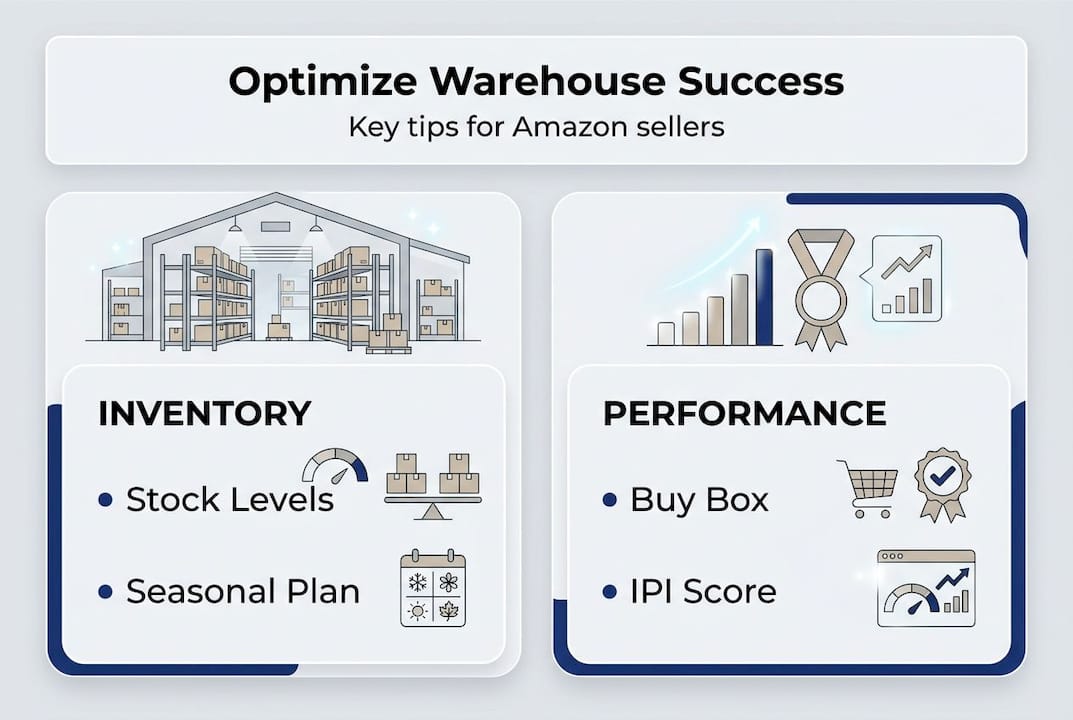
Optimized inventory also feeds directly into Buy Box performance. Amazon’s algorithm favors sellers with consistent stock availability, competitive pricing, and strong IPI scores. Getting all three right is not luck. It’s a system.
Cost controls and maximizing ROI with Amazon warehouse services
Inventory management is just one lever. Next, let’s see how you can make each warehouse dollar count.
The main costs you’ll encounter with Amazon warehousing include:
- Monthly storage fees: Charged per cubic foot, with higher rates from October through December.
- Fulfillment fees: Per-unit charges based on product size and weight, covering picking, packing, and shipping.
- Long-term storage fees: Applied to inventory that has sat in a fulfillment center for more than 365 days.
- Removal and disposal fees: Charged when you pull inventory out of FBA or ask Amazon to dispose of it.
- Inbound placement fees: Newer fees tied to how Amazon distributes your inventory across its network.
Tracking storage fees tightly alongside shipping costs and lost sales opportunities is one of the clearest paths to improving profit margins. For a full breakdown of what each charge covers, the FBA fee explanation from Jungle Scout is a solid reference.
Cost control strategies that actually move the needle:
- Run a monthly aged inventory report and create removal orders for anything approaching the 365-day mark.
- Use Amazon’s Outlet program or run lightning deals to accelerate sell-through on slow movers before fees compound.
- Consolidate inbound shipments to reduce per-unit inbound placement costs.
- Leverage Amazon product strategies to focus warehouse space on your highest-margin, fastest-moving SKUs.
Pro Tip: Set up a custom dashboard in Amazon Seller Central that tracks your storage utilization, IPI score, and aged inventory in one view. Reviewing it weekly takes 15 minutes and can save hundreds of dollars monthly in avoidable fees.
ROI from Amazon logistics tools compounds over time. Every dollar saved on unnecessary fees is a dollar you can reinvest in advertising, new product development, or inventory depth on your best sellers.
Advanced tips: Expanding, scaling, and going international
Once your foundation is strong and costs are under control, what’s the playbook for scaling up or going global?
Multi-Channel Fulfillment (MCF) is the most underused scaling tool available to FBA sellers. It lets Amazon ship your FBA inventory to customers who buy from your Shopify store, your website, or other marketplaces. You maintain one inventory pool and let Amazon’s logistics network do the heavy lifting across channels.
For international growth, go global on Amazon through programs like Amazon Global Selling, which connects you to marketplaces in Europe, Asia, and beyond. The Amazon Global Selling overview outlines how to register, list, and fulfill across multiple regions. But international expansion via Amazon is simplified through warehouse services only when compliance and cost awareness are built into your plan from day one.
Common scaling mistakes to avoid:
- Expanding to new markets before your home marketplace is profitable and stable.
- Ignoring VAT registration requirements in EU countries, which can result in penalties.
- Sending too much inventory internationally without validating local demand first.
- Overlooking currency conversion costs and international return logistics.
- Skipping compliance checks on product labeling, safety certifications, and import restrictions.
Early signals that you’re ready to scale warehouse usage include a consistently high IPI score, strong sell-through rates across your catalog, and reliable supplier lead times. If those three are solid, explore EU sales growth potential as a logical next step.
Why warehouse optimization is more critical than ever in 2026
Here’s an uncomfortable truth: listing optimization alone no longer separates the winners from the rest. In 2026, Amazon’s algorithm increasingly rewards operational excellence, not just keyword-rich titles or beautiful images.
Storage costs have risen. Competition has intensified. Amazon’s own private label presence has grown. In this environment, sellers who treat warehousing as a back-office function are leaving a significant competitive advantage on the table. The sellers gaining ground right now are the ones who connect their FBA listing optimization experience directly to their warehouse strategy, treating both as parts of the same growth system.
“Operational discipline in warehousing is not a cost center. It’s a revenue multiplier when done right.”
The practical profit growth strategies emerging in 2026 all point in the same direction: sellers who master the operational layer of Amazon, including inventory, fees, and logistics, consistently outperform those who focus only on the front-end of their listings. Warehouse strategy is not a support function. It’s a growth lever.
Supercharge your Amazon warehouse performance with expert help
You now have a clear picture of how Amazon warehouse services work and how to use them strategically. The next step is putting it all into action with the right support.

At Searchoneers, we help Amazon sellers connect operational efficiency to listing performance. Our Amazon listing enhancement guide shows you how to align your product content with your inventory strategy for maximum visibility. The listing workflow for success gives you a repeatable process that scales with your catalog. And if you’re ready to sharpen your stock management, our optimize inventory listings resource is the practical starting point. Expert guidance is available whenever you’re ready to scale.
Frequently asked questions
How do Amazon warehouse services work for FBA sellers?
FBA integrates with Amazon’s massive warehouse infrastructure to automate fulfillment and scale sales, handling storage, packing, and shipping so sellers can focus on growth.
What costs should I expect with Amazon warehouse services?
Amazon charges for storage and fulfillment services that directly impact profit margins, so tracking monthly storage, fulfillment, and long-term storage fees is essential for staying profitable.
How do I avoid extra fees or penalties when using Amazon’s warehouse services?
Proper inventory planning helps sellers minimize excess storage fees and penalties, so regularly audit aging inventory and remove slow-moving items before the 365-day threshold triggers long-term fees.
Is Amazon warehouse service suitable for international expansion?
Amazon simplifies international logistics through its warehouse network, but sellers are responsible for meeting local compliance rules including VAT registration, customs, and product certification requirements.
Recommended
- Optimize Amazon Inventory Listings for Higher Sales – Searchoneers
- How to Optimize Amazon Listings: Complete Guide
- Amazon Management Services: Driving Sales With Optimization – Searchoneers
- Boost Sales with an Amazon Optimization Consultant – Searchoneers
- Warehousing & Logistics | Cisco Cloud, Security & Datacenter Experts