

TL;DR:
- Vendor Central is an invite-only platform where Amazon buys products wholesale, controlling pricing and listings.
- Success depends on supply chain discipline, PO compliance, and operational control rather than listing optimization alone.
- Prioritizing PO compliance and logistics accuracy is essential before focusing on content enhancements to grow sales.
Most Amazon sellers assume Vendor Central is just another version of the seller dashboard they already know. It isn’t. Amazon Vendor Central is an invite-only platform where brands sell wholesale directly to Amazon, making Amazon the actual retailer. That single distinction changes everything about how your products are listed, priced, fulfilled, and sold. If you’re operating in Vendor Central or considering an invitation, understanding its mechanics isn’t optional. This guide breaks down what Vendor Central really is, how it differs from Seller Central, and what you can do to protect and grow your sales performance within its unique constraints.
Table of Contents
- What is Amazon Vendor Central?
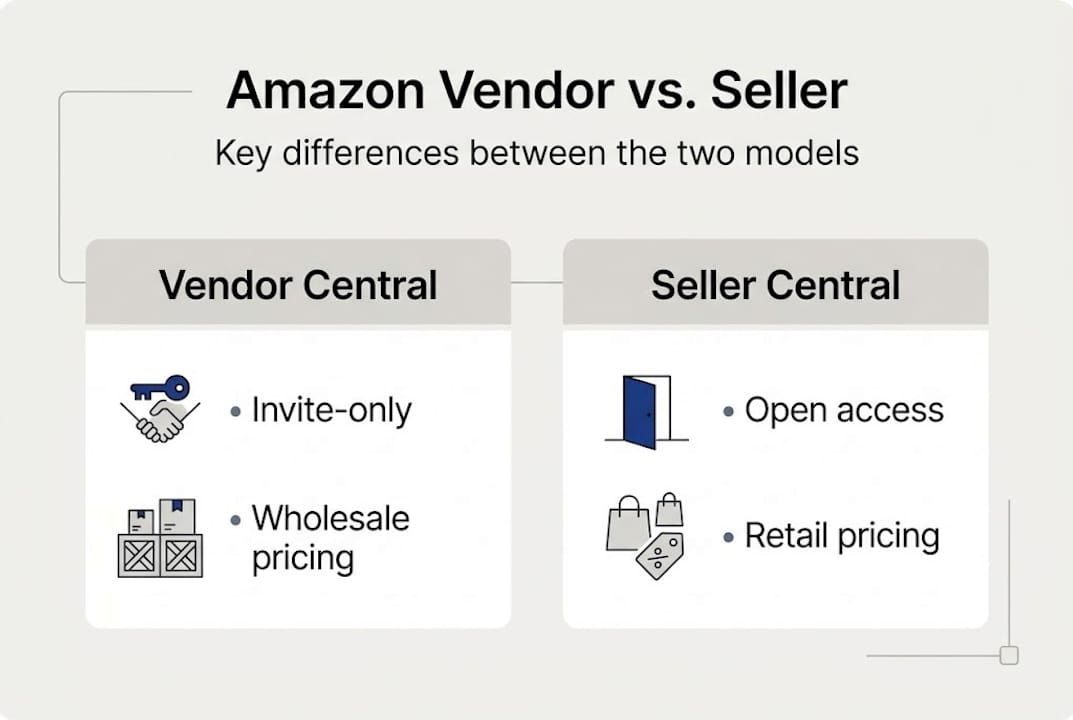
- Vendor Central vs. Seller Central: Key differences
- Vendor Central workflow: From purchase orders to delivery
- How Vendor Central impacts your product listings and sales
- Why treating Amazon as a wholesale partner changes everything
- Take your listings and sales further with expert tools
- Frequently asked questions
Key Takeaways
| Point | Details |
|---|---|
| Vendor Central is wholesale | Amazon buys inventory from you and resells it, rather than letting you sell direct to consumers. |
| Access is by invitation | Only established brands and manufacturers are invited to join Vendor Central. |
| Less control, more scale | Sellers in Vendor Central trade listing control for greater sales reach and Amazon support. |
| PO compliance is crucial | Vendor Central success depends on accurate purchase order management and operational discipline. |
| Optimize what you can | Listing improvement and content enhancements still drive results, even in Vendor Central’s controlled environment. |
What is Amazon Vendor Central?
Vendor Central is not a self-service selling tool. It’s a wholesale supply portal, and access is strictly controlled. Vendor Central is invite-only, meaning Amazon approaches brands and manufacturers it wants to carry, not the other way around. Once accepted, you become a first-party (1P) supplier, selling your inventory to Amazon at wholesale prices. Amazon then resells your products to end customers.
This arrangement flips the typical seller dynamic. You’re no longer selling to shoppers. You’re selling to Amazon, which then handles everything downstream. That includes:
- Fulfillment and shipping to the end customer
- Pricing decisions on the product detail page
- Customer service for orders and returns
- Product listing management on Amazon’s side
One of the most recognizable signals of Vendor Central is the badge that appears on product pages: “Ships from and sold by Amazon.com.” Shoppers trust this label. It signals reliability, fast shipping, and Amazon’s own customer service backing. For many brands, this credibility boost is a major reason to pursue or accept a Vendor Central invitation.
“Amazon Vendor Central is invite-only and allows brands to sell products wholesale directly to Amazon as first-party suppliers.”
But here’s what many sellers don’t realize upfront: once Amazon buys your inventory, you lose significant control. Pricing is Amazon’s call. Listing content is largely Amazon’s call. Your role shifts to supply chain management and content compliance, not storefront management.
For brands exploring the Vendor Central advantages and weighing whether this model fits their business, the key question isn’t “Can I get an invitation?” It’s “Am I ready to operate as a wholesale supplier?” Understanding Vendor Services strategies before you accept that invitation can save you from costly surprises down the road.
Vendor Central vs. Seller Central: Key differences
With Vendor Central defined, it’s crucial to understand how it compares against Amazon’s main alternative. Seller Central is the self-service platform most Amazon sellers know. It gives you direct control over pricing, inventory, customer communication, and listing content. Vendor Central removes most of that control in exchange for scale and credibility.
Here’s a side-by-side comparison of the two platforms:
| Feature | Vendor Central | Seller Central |
|---|---|---|
| Access | Invite-only | Open to all sellers |
| Relationship | Wholesale (1P) | Direct-to-consumer (3P) |
| Pricing control | Amazon sets prices | Seller sets prices |
| Fulfillment | Amazon handles all | FBA or self-fulfilled |
| Listing control | Limited | Full control |
| Customer service | Amazon manages | Seller manages |
| Brand credibility | High (sold by Amazon) | Moderate |
| Margin risk | Higher (wholesale pricing) | Lower |
Vendor Central suits established brands seeking scale and credibility over control, but it carries real risks of margin erosion from Amazon’s pricing policies. That’s not a minor footnote. It’s a structural reality you need to plan for.
Here’s how to think through the decision:
- Assess your volume. Vendor Central works best when you can supply large quantities consistently.
- Evaluate your margin tolerance. Amazon will negotiate hard on wholesale pricing.
- Consider your brand control needs. If content accuracy is critical, Seller Central gives you more flexibility.
- Review your operational capacity. Vendor Central demands supply chain discipline.
- Understand your growth goals. Scale and visibility favor Vendor Central; profitability per unit often favors Seller Central.
Pro Tip: Before accepting a Vendor Central invitation, review your margins at the wholesale price Amazon offers. Many brands discover the credibility boost isn’t worth the margin squeeze without a high-volume strategy in place.
For a deeper breakdown of the self-service option, the Seller Central guide walks through the full feature set. You can also explore how vendor status impacts your brand positioning on the platform.
Vendor Central workflow: From purchase orders to delivery
Once you choose your platform, understanding the day-to-day process is essential for success. In Vendor Central, your operational rhythm is driven almost entirely by purchase orders (POs) sent from Amazon. Amazon decides what it wants, when it wants it, and in what quantity. Your job is to fulfill those POs accurately and on time.
Here’s a simplified view of the core workflow steps:
- Receive a PO from Amazon through the Vendor Central portal.
- Confirm the PO within the required window (typically 2 business days).
- Prepare inventory according to Amazon’s packaging and labeling requirements.
- Ship to Amazon’s fulfillment centers using approved carriers and routing guidelines.
- Submit an Advance Ship Notice (ASN) to notify Amazon of the incoming shipment.
- Invoice Amazon after shipment confirmation.
- Monitor compliance metrics in your Vendor Central dashboard.
PO compliance is not a background concern. It’s the foundation of your vendor relationship. Treating Amazon as a wholesale partner means prioritizing PO compliance above content optimization. Amazon tracks your fill rate, on-time delivery, and label accuracy. Poor performance triggers chargebacks, which are financial penalties applied to your invoices.
| Compliance metric | What Amazon measures | Impact of failure |
|---|---|---|
| Fill rate | % of ordered units shipped | Chargebacks, reduced POs |
| On-time shipment | Delivery within PO window | Chargebacks, delisting risk |
| Label accuracy | Correct FNSKU and packaging | Receiving delays, penalties |
| ASN accuracy | Correct shipment data submitted | Processing delays |
Pro Tip: Set internal deadlines 24 hours ahead of Amazon’s PO confirmation window. This buffer protects you from last-minute inventory or logistics issues that could hurt your compliance score.
For brands managing complex fulfillment setups, understanding Vendor Flex fulfillment options can provide flexibility. And if you’re navigating chargebacks or compliance disputes, Vendor Central compliance resources can help you build a stronger operational foundation.
How Vendor Central impacts your product listings and sales
With workflow covered, let’s see how Vendor Central shapes your listings and sales performance. This is where many brands feel the tension most acutely. You’ve built a product, invested in branding, and now Amazon controls much of how it appears to shoppers.

Amazon handles fulfillment, pricing, customer service, and lists products as “Ships from and sold by Amazon.com.” That means the listing content you submit through Vendor Central may be overridden, merged with existing data, or changed without notice. Amazon uses its own algorithms and data to determine what appears on the product detail page.
Here’s what Vendor Central affects on your listings:
- Titles and bullet points can be edited by Amazon or overridden by catalog data
- Pricing is set by Amazon based on its retail pricing strategy
- Images are subject to Amazon’s content guidelines and may be replaced
- Product categorization is managed by Amazon’s catalog team
- Buy Box is almost always won by Amazon when it’s the seller, boosting conversion rates
- Reviews accumulate faster due to higher sales velocity from Amazon’s promotion
The good news is that you’re not completely powerless. Vendors can submit Enhanced Brand Content through A+ Content, which adds rich visuals and storytelling to product pages. You can also work on inventory listing optimization to ensure your product data is accurate, complete, and compliant before Amazon processes it.
Pro Tip: Submit the most complete and accurate product content possible during onboarding. Amazon’s systems pull from this data first, so strong initial content reduces the chance of inaccurate overrides later.
Understanding product compliance basics is equally important. Products with incomplete or non-compliant data are more likely to be suppressed or incorrectly categorized, which directly hurts your sales velocity and search visibility.
Why treating Amazon as a wholesale partner changes everything
Most brands entering Vendor Central focus almost entirely on listing optimization. Better titles, sharper bullet points, richer images. That work matters, but it’s not what separates high-performing vendors from struggling ones. The real differentiator is operational discipline.
Vendor Central is a wholesale arrangement. Amazon’s priorities are inventory reliability, fulfillment accuracy, and supply chain consistency. When you treat Amazon like a retail customer browsing your storefront, you miss the point entirely. When you treat Amazon like a demanding wholesale buyer with strict compliance requirements, everything shifts.
Prioritizing PO compliance over content isn’t a compromise. It’s the correct hierarchy. Brands that master their supply chain, hit their fill rates, and avoid chargebacks earn more frequent and larger POs over time. That volume growth compounds. It leads to better placement, more reviews, and stronger sales velocity without spending more on advertising.
Content optimization is still valuable. But it’s the second layer, not the first. If your operations are leaking money through chargebacks and your PO compliance score is mediocre, no amount of A+ Content will fix your Vendor Central performance. Build the operational foundation first, then layer in content excellence. Vendor consulting for PO compliance can help brands identify where their supply chain is creating friction before it becomes a pattern.
Take your listings and sales further with expert tools
If you’re ready to put these strategies into practice, here’s how Searchoneers can help. Navigating Vendor Central’s listing constraints and compliance requirements takes more than a checklist. It takes a structured approach built specifically for Amazon’s wholesale environment.
At Searchoneers, we help Amazon vendors enhance Amazon listings with content that works within Vendor Central’s rules while maximizing visibility. Our listing optimization workflow is designed for sellers who want a repeatable, data-backed process. Whether you’re onboarding new SKUs or fixing suppressed listings, we also offer targeted support to help you optimize inventory listings for higher sales performance. The strategies in this guide are a starting point. We help you execute them at scale.
Frequently asked questions
Is Amazon Vendor Central open to all brands?
Vendor Central is invite-only and typically reserved for established brands and manufacturers that Amazon selects based on product demand and supply capacity.
What are the main downsides of Vendor Central?
Brands lose control over pricing and listing content, and margin erosion from Amazon pricing is a real risk, especially for vendors without high-volume wholesale margins built in.
How does Amazon handle vendor fulfillment and PO compliance?
Amazon sends purchase orders to vendors, and PO compliance is tracked through metrics like fill rate and on-time delivery. Poor compliance results in chargebacks and reduced future orders.
Can Vendor Central sellers optimize their product listings?
Yes, but with limits. While Amazon manages fulfillment and pricing, vendors can still submit A+ Content and accurate product data to improve visibility within the platform’s constraints.
How do I maximize my sales performance through Vendor Central?
Focus on PO accuracy and compliance first, then layer in content improvements. Prioritizing PO compliance over content is the mindset that separates high-performing vendors from the rest.
Recommended
- Optimize Amazon Inventory Listings for Higher Sales – Searchoneers
- How to Optimize Amazon Listings: Complete Guide
- Amazon listing checklist: optimize for sales and visibility – Searchoneers
- Amazon Listing Enhancement Guide for Higher Sales – Searchoneers
- Optimize eCommerce with 3D asset lifecycles: a guide

Comments
One response to “Amazon Vendor Central: Optimize Your Listings and Sales”
[…] platform, regardless of size, must meet Amazon’s EDI requirements to process orders efficiently. EDI integration streamlines order processing and reduces manual errors, which is why Amazon treats it as a non-negotiable part of the vendor […]